


















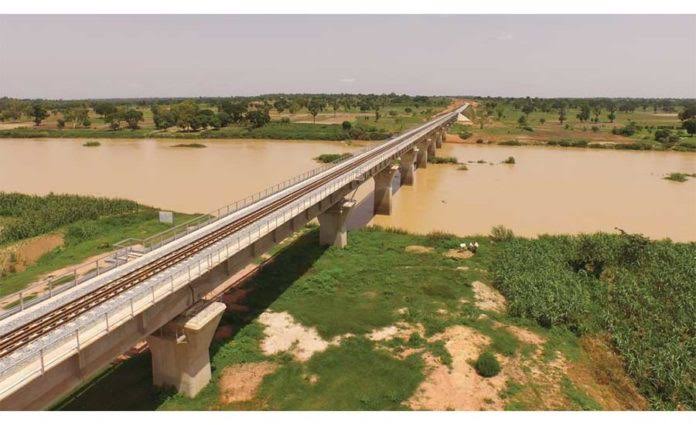
In what has become the first modern double-track standard railway in the West Africa region, a railway project connecting Nigeria’s city of Lagos, Africa’s largest city, to the country’s industrial base Ibadan, has been officially launched.
NCNC gathered that the railway, stretching about 157 kilometers (km) with a speed of 150 km/h, marks a landmark cooperation project between China and Africa under the Belt and Road Initiative (BRI) that will significantly improve Nigeria’s infrastructure and boost its economic development.
The railway, which was commissioned by President Muhammadu Buhari, was designed, built and undertaken by China Civil Engineering Construction Corporation (CCECC). The Export-Import Bank of China provided the funds, reports said.
Speaking with newsmen, Jiang Yigao, general manager assistant of CCECC and executive director of CCECC’s Nigeria Co, said it only took about three years for the project to be completed, which set a record for the fattest construction speed of Chinese enterprises’ rail project in West Africa.
It would be recalled that an inauguration ceremony for the construction was held in March 2017. In March 2020, construction of the main line of the Lagos-Ibadan section was completed, and a trial run was conducted on December 2020. In January, a branch connecting the main section with Apapa port in Lagos – also Nigeria’s largest port city – was completed.
Jiang said “This year also marks the 50th anniversary of China and Nigeria establishing diplomatic ties, so the project’s official operation will further facilitate bilateral economic cooperation and bilateral ties”.
The GM averred that Chinese and Nigerian workers have worked together, dealing with a complex environment, lack of materials, and the sudden outbreak of the COVID-19 pandemic, for Nigeria to realize its modern railway dream.
He said “We have overcome a lot of technological barriers during the construction, and we also communicated with Italian consulting firms to convince them using modern railway standards,” adding that thanks to effective epidemic-prevention measures and abundant supply of medical gear, the project was only suspended for a very short time.
Also speaking to newsmen, Liu Zhengqiang, vice general manager of CCECC Fuzhou Survey and Design institute, noted that the Chinese design team in Nigeria has been running in full swing to address technological barriers, especially in downtown Lagos.
Liu said “We have to lay five rail track lines within the corridor with width of merely 30 meters. Also, plenty of underground utilities were involved, posing barriers to construction. In addition, the insufficient clearance of existing highway-over-railway and the complex existing municipal drainage system also restricted the plan,” noting that through multiple communications and repeated study with the client, consultants and property owners for more than a year, the design was finalized.
The vice GM also stated that the “Lagos-Ibadan railway construction will leverage the radiation effect of the Lagos in the North of Nigeria, promoting the coordinated development of regional economy”.
Liu added that the project could also further drive the resource exploration of areas along the railway, and facilitate the process of industrialization and urbanization.