


















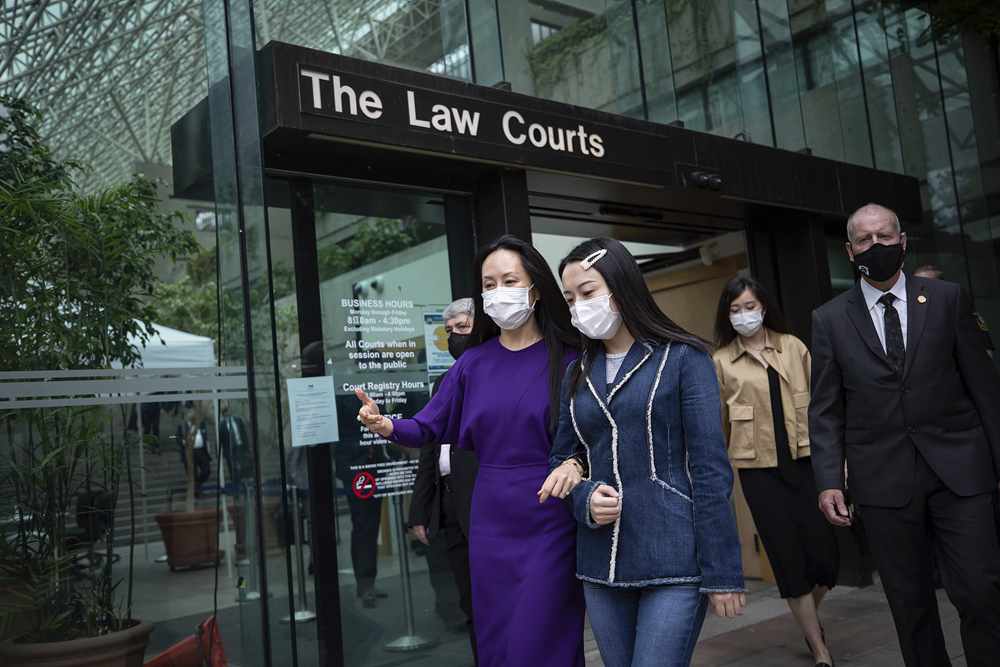
The fight of Chinese Huawei executive, Meng Wanzhou in a Canadian court against extradition to the United States to face charges related to fraud and conspiracy was recently wrapped after almost 1,000 days of legal tussles and diplomatic brawls.
Meng, the daughter of Huawei’s founder and CEO, Ren Zhengfei, is accused of defrauding HSBC Bank by falsely misrepresenting connections between Huawei and Skycom, a subsidiary that sold telecoms equipment to Iran.
According to the US Justice Department, this put the bank at risk of violating US sanctions against Tehran, as it kept on clearing US dollar transactions for Huawei.
Supreme Court of British Columbia Associate Chief Justice Heather Holmes said the date will likely be set by her on October 21 to deliver her ruling.
49-year-old Meng is living in a Vancouver mansion on bail conditions that include a curfew and electronic monitoring, as she awaits the result of her extradition proceedings.
Meng could face more than 30 years in a US prison If she is transferred to the US for trial and subsequently gets convicted,
However, China’s foreign ministry has said that Meng’s case was “entirely political” and was aimed at suppressing Chinese enterprises.
The spokesperson of the Chinese Foreign Ministry said: “We urge Canada to immediately correct its mistake, to release Meng Wanzhou and allow her to return home safely as soon as possible.”

Meng was arrested in December 2018 during a stopover in Vancouver. The arrested has caused a deep diplomatic rift between Canada and China, which has accused the United States of attempting to crush its international tech giant Huawei.
A few days later, China detained two Canadians, businessman Michael Spavor and former diplomat Michael Kovrig, in what many nations have labelled “hostage diplomacy.”
Both Canadians were tried in March for espionage — charges that Canadian Prime Minister Justin Trudeau described as being “trumped up.” Spavor was recently sentenced to 11 years in prison as the final arguments in Meng’s case got underway.
During a recent hearing, Meng’s lawyers rejected the US allegations against her, accused Canadian and US officials of abuse of process and demanded her release.
Defence lawyer Mark Sandler argued there was no deceit and no loss or risk of loss to HSBC, telling the court: “We have turned fraud law on its head in this proceeding.”
Canadian government lawyers that represented the interest of the US in the hearing countered that the arguments of the defence were best aired at a trial and that the judge should commit Meng for extradition.
To make this happen, Associate Chief Justice Holmes only needs to discover there is sufficient evidence to go to trial.
“No one has received a fairer extradition hearing in this country than Ms Meng,” Crown Attorney Robert Frater insisted.
However, both Canadian and US authorities have denied any abuse of process in the case.