


















By Stanley Ugagbe
Recently, Mali has been a major headline in the news across Africa and the rest of the world. But there had been a huge build up to the latest there, Africanews reports.
There have been series of demonstrations calling for the resignation of President Ibrahim Boubaca Keïta who was eventually forced out of office by a military junta.
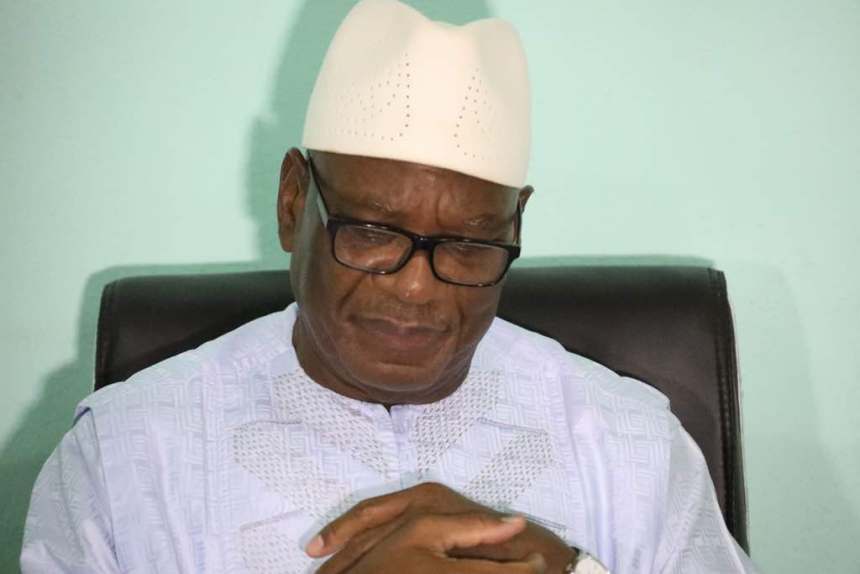
In what was heartwarming news to many Malians, IBK on the evening of August 18, hours after soldiers had seized him and his vice Boubou Cisse, announced he was leaving power.
However, local reports have unraveled the story behind development. The events that culminated to the ousting of the President as detailed by the Africanews are reproduced below.
An opposition coalition known as the “June 5 Movement” and led by prominent Islamic cleric Mahmoud Dicko, had for months in the aftermath of the April legislative and local council elections, been criticising President Keita. Mahmoud Dicko can best be described a man with a cult following.
Malians in their thousands soon took to the streets in protests. A constitutional court decision to overturn some of the election results, which the opposition says helped to keep members of Keita’s ruling party in office could very well have been the straw that broke the camel’s back.
The demonstrations would later evolve into a total rejection of Keita’s administration and an outright demand for his resignation.
The issues Malians complained about were clear.
Since 2012, Mali had been struggling to contain a jihadist rebellion that erupted in the northern part of the country and had spread with attacks to some cities in the central parts. Thousands of civilians and military personnel have been killed in the conflict.
Former colonial power, France, sent in troops. Its operation Barkhane force with 5000 troops stationed, and worked to fight off jihadists in the larger sahel region that includes Chad, Burkina Faso, Mauritania and Niger.
President Keita in February said that his government representatives had made contact with two of Mali’s extremist leaders- Amadou Koufa and Iyad Ag Ghaly. But attacks continued unabated. It was often not the question of when it would end, it was more about when would the next attack happen. The subject became top amongst the burning issues for the country, – the protracted jihadist conflict in the north.
But there were even more issues for the populace. Corruption, discontent over April’s parliamentary election, and poverty.
ECOWAS steps in to mediate.
With the unrest unrelenting and with fears of it further destabilizing a region already battling a rise in extremism, regional bloc ECOWAS, – the Economic Community of West African States -stepped in with serious mediation efforts.
It called for the formation of a unity government, the resignations of lawmakers whose elections were disputed. And, there were also demands for a new election.
President Keita’s cabinet by now had resigned and in July, a new one had been formed supposedly with few changes to appease the opposition. But it seemed nothing Keita would do could save him as the brokered meetings by ECOWAS, with him (Keita) and senior opposition members often resulted in dead ends.
The Army struck.
As this process was going on, young soldiers in the country’s military were having their plans. They seized power.
The coup sent shockwaves around west Africa and France, Mali’s top ally and former colonial leader. This was yet another coup. Actually, the second Mali has seen in eight years.
What next now for Mali?
Negotiations between envoys from ECOWAS and Mali’s new military rulers are now taking place. Though ECOWAS in its first reactions to the coup slammed sanctions on Mali, and shut its borders with the country, they are as of today trying to push for a swift return to civilian rule. But it remains to be seen just how this would turn out.
President Keita who was seized by soldiers during the coup has now been released. His release spearheaded also by ECOWAS, under the auspices of former Nigerian President Goodluck Jonathan. But what next now for Mali?
The world watches on to see the unfolding of events capable of either repositioning the west African state for growth and development or even greater chaos.
Ibrahim Boubacar Keïta, Mali’s ousted president, was released from detention and driven to his home in the West African country’s capital early Thursday, nine days after a military coup brought an end to his seven years in power.
A heavy security escort took Mr. Keïta to his house in Sebeninkoro, a residential neighborhood of Bamako, the latest twist since his abrupt fall last week, after military officers with guns arrested him, took him to their base and forced him to announce on television that he and his entire government had resigned.
Leaders of the coup, in announcing his release, did not specify whether the 75-year-old former president was still subject to any restrictions.
They had held him in Kati, 10 miles outside Bamako, along with his prime minister, Boubou Cissé, and several other high-ranking government officials. Mr. Cissé and the former ministers of defense and security remain in custody.
The forced resignations of Mr. Keïta and his subordinates came after several months of growing and persistent protests. The coup plotters — who refer to themselves as the National Committee for the People’s Salvation — have presented themselves as having carried out the will of the people.
The coup was roundly condemned by the African Union, the United Nations, the United States and France — which has around 5,000 troops in the region. But only Ecowas, the regional organization of West African states, initially tried to insist that Mr. Keïta be reinstated, holding a video conference call attended by all the region’s presidents.
The coup leaders have met with opposition figures and protest leaders, promising to hold democratic elections and find an interim president.
In negotiations with Ecowas, the leaders of the junta initially asked for a three-year transition led by a military officer. Ecowas mediators said on that they would accept a transitional government with a civilian or retired army officer in charge for a maximum of one year, according to a statement from the Nigerian presidency. The Ecowas mediators also said they wanted Mr. Keïta freed.