


















Britain’s economy slowed last year to its weakest growth rate since the global financial crisis as mounting uncertainty over Brexit weighed on businesses and kept a lid on their investments, official figures showed Monday.
The Office for National Statistics said that the British economy grew by a quarterly rate of only 0.2 percent during the fourth quarter, down from the 0.6 percent tick recorded in the previous three-month period. Output actually fell in the month of December, by 0.4 percent from November, though monthly data are known to be volatile.
For 2018 as a whole, the economy grew by 1.4 percent, its lowest rate since 2009, when it contracted by 4.2 percent in the wake of the global financial crisis that had brought much of the world’s banking system to its knees.
Britain’s economy was likely hurt by global trends, such as trade tensions between the U.S. and China that have weighed on world growth. And many trading partners in Europe, such as Germany and Italy, have suffered a slowdown.
But there is plenty of evidence that uncertainty around to the country’s departure from the European Union was the main factor weighing on the economy, particularly on business investment.
In the fourth quarter, business investment fell by 1.4 percent for the fourth straight quarterly decline — the first time that has happened since the financial crisis.
With less than 50 days to go to Brexit day on March 29, firms have no idea what the country’s new trading relationship with the EU will look like, so they’re taking a safety-first approach.
The statistics agency’s head of GDP figures, Rob Kent-Smith, said the slowdown in the last three months of the year was particularly “steep” in car manufacturing and steel production, offset by continued growth in the services sector, which makes up around 80 percent of the British economy
Though Britain’s Treasury chief Philip Hammond argued that the British economy remains “fundamentally strong” and is “enjoying the longest unbroken quarterly growth streak” among the Group of Seven industrialized countries, he conceded Brexit unease was taking its toll.
“There is no doubt that our economy is being overshadowed by the uncertainty created by the Brexit process,” he told Sky News. “I’m afraid this has gone on longer than we would have liked.”
While the British economy largely held up better than expected in the immediate aftermath of the June 2016 vote to leave the European Union, firms are getting edgier as Brexit day draws nearer — the government had expected to be ratifying a withdrawal agreement with the EU by now.
There is no sign that the uncertainty, described as the “fog of Brexit” by the Bank of England, is going to lift anytime soon, so the economy is not expected to have improved at the start of this year.
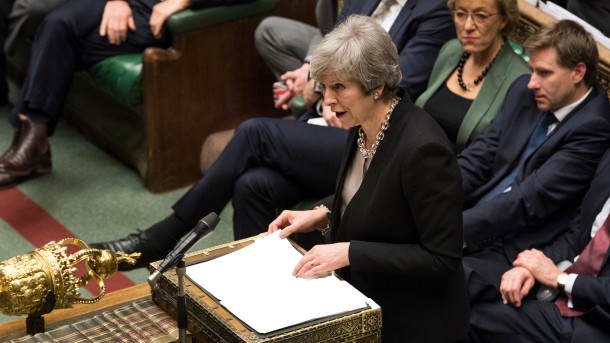
Prime Minister Theresa May is struggling to salvage the Brexit deal she agreed on with the EU late last year after it was overwhelmingly rejected by British lawmakers. She’s trying to eke out concessions from the EU, particularly on a controversial provision intended to make sure no hard border returns between EU member Ireland and Northern Ireland, which is part of the United Kingdom.
It’s unclear she will be able to get any concessions and fears have grown in recent weeks that Britain could crash out of the EU without a deal. That’s a worst-case scenario that the Bank of England has said could see the British economy shrink by 8 percent within months and house prices collapse by around a third as trade barriers like tariffs are put up on EU-U.K trade.
In 2018, net trade was a drag on the British economy as it imported more than it exported, a possible reflection of the waning effects of the prior year’s fall in the pound and a slowing global economy.
Analysts were careful not to conclude that the British economy would start contracting in the first quarter of 2019, not least because British consumer spending tends to be resilient.
“Today’s data bring clear signs that Brexit uncertainty is depressing the economy, but we would not rush to conclude yet that GDP is on track to fall outright in the first quarter,” said Samuel Tombs, chief U.K. economist at Pantheon Macroeconomics.
“Solid growth in households’ spending, thanks to low inflation and robust labor income growth, should keep GDP on a slightly rising path.”
Source: www.tvnz.co.nz