


















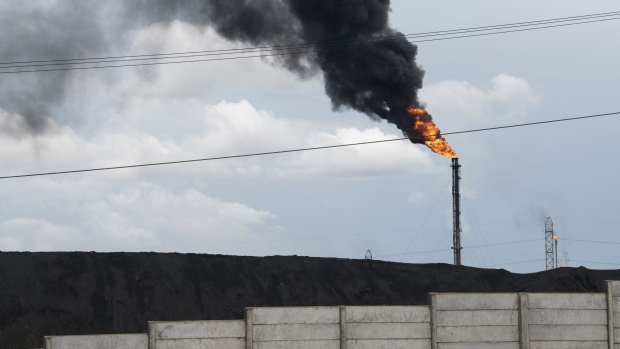
The government of Venezuela has begun talks with the European Union on a $1.5 billion plan to capture its methane emissions and export them to the bloc as natural gas with the help of Eni SpA and Repsol SA.
According to people with knowledge of the situation and documents seen by Bloomberg, the project would use a portion of the EU’s Global Gateway Initiative funds to gather emissions from Venezuela’s idle oil wells and deteriorating infrastructure. That gas would then be sent to Trinidad to be liquefied and shipped on to Europe.
Reports have it that the plan would help Venezuela, once one of the world’s largest crude producers, reduce the pollution from the state-owned oil company’s facilities while bolstering the EU’s natural gas supplies amid Russia’s war with Ukraine. It is germane to clarify that methane is a greenhouse gas that’s about 80 times more potent than CO2 over a 20-year period.
A spokesperson for the European Commission disclosed that discussions are still at a very preliminary stage, adding that a feasibility study to ascertain the scope of the repairs will be the first step, with financing arrangements still to be agreed upon.
Though no exact start date has been established, the project is slated to be ready in about two years. Venezuelan Vice President Delcy Rodriguez who confirmed the plan, did not provide additional details. It was gathered that Italian energy giant Eni, Spain’s Repsol and France’s Etablissements Maurel & Prom SA will handle some of the work of overhauling Petroleos de Venezuela SA’s gas hubs, plants and pipelines.
According to documents, the plan includes the construction of a 90-kilometer (56-mile) pipeline connecting Venezuela and Trinidad for about $350 million and would take about 36 to 48 months from research until construction. PDVSA, Eni, Repsol and Maurel et Prom didn’t immediately reply to requests for comment.
Records have it that Venezuela has the second-highest methane emissions intensity — trailing only Turkmenistan — among selected oil and gas producing countries, according to International Energy Agency data. The South American nation flared and vented around 1.2 kilograms (2.7 pounds) of methane per gigajoule of energy produced.
According to authorities, leaders of the European Union are seeking to reboot relations with Latin America in a competition for influence against Russia and China, but wrangling over Moscow’s invasion of Ukraine is hampering their efforts.
Recently, the EU announced that it will help invest more than $50 billion in Latin America and the Caribbean until 2027 in clean energy, critical raw materials, health and education. EU’s foreign affairs chief Josep Borrell pointed out the need to help Venezuela lower emissions in an interview in El Pais in May.
Speaking with newsmen, Borrell said Venezuela “is one of the countries that produces the most methane for the benefit of no one, while in the EU we need gas. We are thinking of a project that allows this gas to be extracted, taken to Trinidad and Tobago so that it can be liquefied there, and sent to Europe.”
SUPPORT NIGERIAN CANADIAN NEWSPAPER CANADA
If you like our work and want to keep enjoying what we offer, kindly support us by donating to the Nigerian Canadian News by clicking here
Share your thoughts in the comments section below
Do you want to share any news or information with us? If yes, contact the publisher at publisher@test1.nascitest.club