


















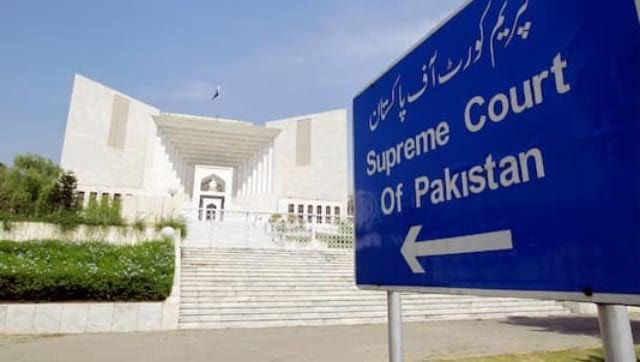
The Supreme Court of Pakistan has adjourned without deciding on the legality of Prime Minister Imran Khan actions in blocking an opposition attempt to oust him, an action that has led to political uproar in the nation.
According to reports, Khan, a former cricket star, lost his majority in parliament as his opponents-built support in advance of a vote of no-confidence that had been due.

But the move was thwarted as the deputy speaker of parliament, a member of Khan’s party, threw out the no-confidence motion that Khan had been widely expected to lose, ruling it was part of a foreign conspiracy and unconstitutional. Afterwards, Khan dissolved the parliament.
Local reports have it that the development has thrown the country of 220 million people, which the military has ruled for almost half its history since independence in 1947, into a full-blown constitutional crisis.
The PM decision has been challenged by Pakistan’s opposition in a legal case that began with five-member Supreme Court bench hearing arguments in a packed courtroom.
But despite a three-hour hearing, the supreme court failed to come to a verdict, adjourning the case.
“The ruling was unlawful – why?” Chief Justice Umar Ata Bandial told lawyers for Pakistan’s opposition.
Analysts believe that irrespective of what the Supreme Court decides, the nuclear-armed nation looks to be heading for a fresh election before the completion of the current term of the parliament and the prime minister in 2023.
It was clarified that If Khan prevails, polls will happen within 90 days. The opposition also wants an early election, albeit after delivering a political defeat to Khan by ousting him through a parliamentary vote.
In a statement, opposition leader Shehbaz Sharif called the blocking of the vote “nothing short of high treason”.
“The nation is stunned,” the English-language Dawn newspaper said in an editorial.
“Even as political pundits and the media confidently predicted Mr Imran Khan’s defeat in the vote of no-confidence, he seemed unperturbed. No one could have guessed that his last ploy would involve having the democratic order burnt down.”
It was also reported that Khan dissolved the cabinet and wants a general election within 90 days, although that decision officially rests with the president and the election commission, and depends on the outcome of the court hearing.

Meanwhile, President Arif Alvi has in a statement said Khan would stay on as prime minister in an interim role until a caretaker prime minister was appointed under whom a general election would be held.
The president’s office said in a statement that Alvi has written to both Khan and Sharif, asking them to put forward names for a caretaker prime minister within three days.
However, whether an election will happen depends largely on the outcome of the legal proceedings.
Justifying his action, Khan said he did not act unconstitutionally, calling the move to oust him a plot orchestrated by the United States – a claim Washington denies.