

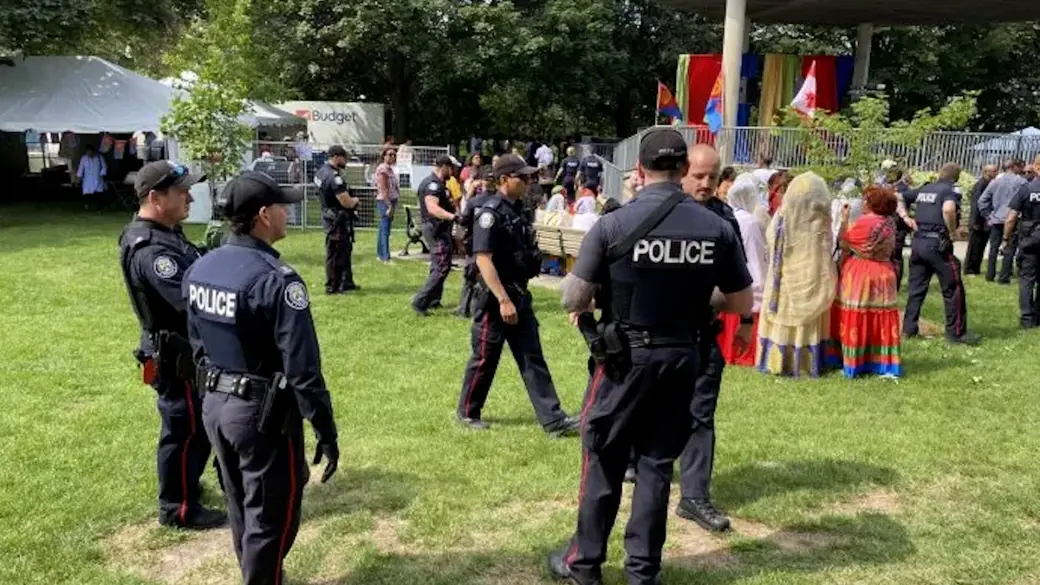
An Eritrean festival scheduled at Earlscourt Park in Toronto was disrupted by protesters, leading to violent clashes involving a knife-wielding individual, as reported by the police.
The confrontation between Festival Eritrea attendees and protesters escalated, resulting in injuries. Following police intervention, the festival briefly resumed, only to face further disruptions with the arrival of more protesters armed with weapons. The conflict eventually spilled over from the park onto St. Clair Avenue West. The City of Toronto took the step of revoking the festival’s permit, a decision made 12 hours after the skirmishes began.
Both the festival organizers and protesters are part of Toronto’s Eritrean-Canadian community. Eritrea’s government has faced extensive criticism from human rights groups, earning a reputation as one of the world’s most oppressive regimes. Eritrea gained independence from Ethiopia three decades ago, and President Isaias Afwerki has maintained power without holding elections. Millions have fled the country to avoid forced military conscription and dire conditions.
In early 2023, the United Nations Human Rights Office released a report describing the dire and unimproved human rights situation in Eritrea, citing credible accounts of torture, arbitrary detentions, enforced disappearances, and curtailed rights like peaceful protest. The country lacks elections, a parliament, independent media, and opposing political parties, as highlighted in the report.
Awet Weldemichael, an expert on the Horn of Africa from Queen’s University, expressed the unimaginable conditions in Eritrea. The same ruling party and president have controlled the nation since its independence in 1998, maintaining a state of war and enforcing lengthy conscriptions in the military.
Escaping Eritrea involves hazardous journeys, often spanning the Sahara Desert and the treacherous Mediterranean or Atlantic crossings before reaching Europe. Trauma from these experiences is hard to fathom.
Weldemichael noted the direct link between the Toronto festival and Eritrea’s ruling party. He emphasized that while the event has a cultural history, it is intrinsically political, aligned with the government’s ideology and goals.
In a Change.org petition, over 1,700 individuals urged Toronto’s Sheraton hotel to cancel a segment of the Eritrea Festival due to its association with the government’s totalitarian regime. The petition contended that the event contributes funds to support the regime’s military.
Protesters, many of whom fled Eritrea seeking refuge, are concerned that a festival connected to the oppressive regime will trigger painful memories. They see the ruling party celebrating itself and spreading propaganda while raising funds, compounding their trauma.
Similar tensions were witnessed at a Sweden festival, where protesters disrupted the event. The perspectives of festival organizers and protesters differ significantly. The Coalition of Eritrean Canadian Communities and Organizations (CECCO), which supported the festival, claimed that peaceful attendees were targeted, requesting police support prior to the event.
The CECCO criticized the permit revocation, branding protesters as violent extremists and suggesting that the City’s decision endorsed their disruptive agenda. Lambros Kiriakakos, CECCO’s chair, defended the festival’s patriotic nature, asserting its alignment with Eritrean society institutions, NGOs, and various representatives.
Opponents of the festival argue that it bolsters a repressive regime by financing its operations, including forced conscription. Dawit Demoz, aligned with the protesters and an Eritrean refugee, highlighted the trauma induced by the event’s association with the government that caused their escape. He pointed out the lack of economic opportunities and the regime’s reliance on the diaspora for support.
Democratization of Eritrea is hindered by the festival’s link to the regime, which represents a stark generational divide. Those who experienced Eritrea under Ethiopian rule link the current government to independence, while younger refugees directly experienced the regime’s brutality.
In response to violent incidents, the City of Toronto prioritized public safety and revoked the festival permit, originally intended for the long weekend.
SUPPORT NIGERIAN CANADIAN NEWSPAPER CANADA
If you like our work and want to keep enjoying what we offer, kindly support us by donating to the Nigerian Canadian News by clicking here
Share your thoughts in the comments section below
Do you want to share any news or information with us? If yes, contact the publisher at publisher@test1.nascitest.club


