

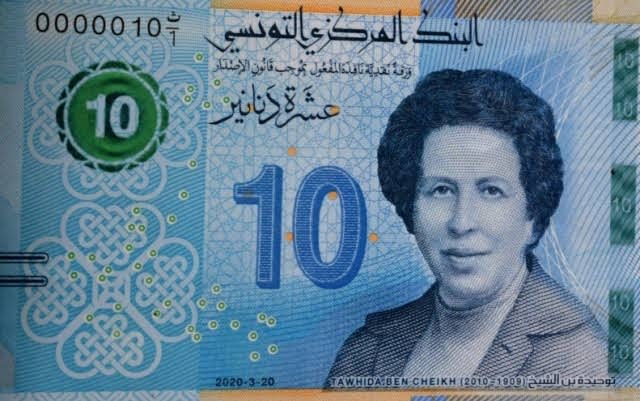
Tunisia’s first female doctor, Tewhida ben Sheikh recently became a household name as the nation’s apex bank unveiled new banknotes honoring her.
In a statement, the Central Bank disclosed that the new 10 Tunisian dinar note would feature the late female doctor who was a physician and gynecologist.
The iconic doctor who was born in 1909 passed on a decade ago, in 2010. Records have it that she was the first Muslim woman to become a physician in North Africa in the 20th century, and is particularly renowned for her work in women’s health and specialization in gynaecology.
We gathered that in 1928, she became the first woman to attain a high school baccalaureate and eventually specialized in gynaecology, heading campaigns around access to contraception and abortion which precipitated the legalization of abortion in 1965.
Remarkably, in 1973, she founded the country’s first family planning clinic, and became one of the most active voices in support of family planning and abortion access, even instructing doctors in abortion procedures.
The new note went into circulation on March 27, as legal tender. It will circulate alongside the country’s other currency. The country uses coins and banknotes. The dinar is subdivided into 1,000 milim or millimes.
Currently, there are coins of 5, 10, 20, 50 and 500 millimes and 1, 5 and 10 dinars in circulation. With respect to banknotes there are 5, 10, 20 and 50 dinars.
The nation’s apex bank also noted that the new note has several security features, including:
A watermark through the image of Ben Sheikh and the number 10 that can be seen when looking at the note through light.
A windowed security thread that appears continuous when looked at over a light, but discontinuous otherwise.
A circle on the upper left corner containing the number 10 that changes color depending on the angle of view.
Reports have it that Ben Cheikh is the first female doctor to appear on a Tunisian banknote, but not the first woman. The ten-dinar note had also previously featured Queen Elissa – or Dido – who is credited to being the founder and Queen of Carthage, an ancient empire that existed where Tunisia now rests.
According to the Global Exchange website, the dinar was set out as the new currency in Tunisia in 1958, although it did not start to be used until 1960. Until that moment, the official currency had been the franc and the equivalence to the new currency was of 1,000 francs to 1 dinar.
The Tunisian dinar is commonly abbreviated DT, although the word “dinar” placed after the number is also accepted. Importing and exporting dinars is forbidden in Tunisia. Every year, each Tunisian is allowed to exchange up to 6,000 dinars in foreign currency before leaving the country.


