



















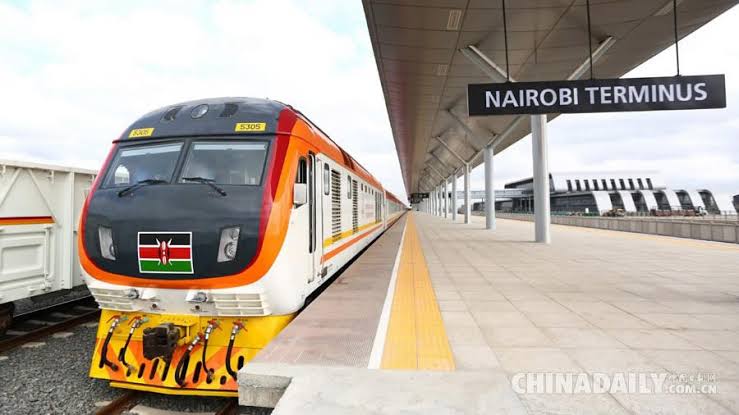
When Kenya was availed a $3.2 billion loan by China in 2014 to build the Standard Gauge Railway (SGR) that will connect Nairobi and Mombasa, critics labeled the project as costly and were highly worried about the project’s debt burden on Kenya.
Independent observers felt the agreement was overpriced and there have since been questions about how the loan was structured. Amid a growing worldwide economic crisis these questions have become more meaningful and urgent as far as the very financial viability of the project is concerned.
Also, there has been questions about whether Kenya will be able to pay back the Chinese loans which have totalled $4.7 billion after the loan was enhanced in 2015 by another $1.5 billion to construct additional 75 miles to Naivasha, a town northwest of Nairobi.
Kenyan lawmakers recently tabled a report in parliament and advised the government to follow the footsteps of Ethiopia and renegotiate the terms of the Chinese loan for the SGR “due to the prevailing economic distress occasioned by the effects of Covid 19″.
In the report, lawmakers recommend that the government should renegotiate the SGR operation agreement “by planning to reduce operation costs by at least 50%”. It has not been easy as the SGR operators had to stop its passenger service for almost three months owing to concerns about the potential transmission of the pandemic.
The China Road and Bridge Corporation, which built the railway, carries out the railway’s passenger and cargo service via its subsidiary, the Africa Star Railway Operation company. In three years of SGR’s operation, the expenditure of Africa Star Railway Operation has always exceeded its revenue and this vacuum is being filled with Kenyan taxpayers money.
Kenya’s transport ministry’s report that was presented to parliament in 2018 revealed that the railway made a loss of KSh9.8 billion ($90.3 million) in its first year of operation against the projected a profit of $46.8 million for the following year by the government.
However, the ministry’s 2020 report which was also tabled to parliament reveals that the railway made a loss of $200 million in three years. The document reveals that the railway generated revenues of $230.7 million but had operational costs of $430.5 million during this period.
The transport ministry has adduced limited storage capacity at a Nairobi container depot, inadequate use of Nairobi’s freight terminal and railway charges as reasons for this performance.