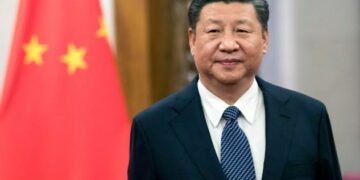




















The President of China, Xi Jinping has warned against a return to Cold War-era divisions in the Asia-Pacific as tensions mounted over the security of Taiwan.
Speaking at a virtual business conference on the sidelines of the Asia-Pacific Economic Cooperation summit hosted by New Zealand, Jinping said “Attempts to draw ideological lines or form small circles on geopolitical grounds are bound to fail”

“The Asia-Pacific region cannot and should not relapse into the confrontation and division of the Cold War era.”
The Chinese leader’s call came shortly after China and the United States announced a surprise pact to accelerate climate action at a summit in Glasgow where countries are trying to agree on measures to curb the warming of the Earth.
Though Xi did not mention the US deal directly, he said “all of us can embark on a path of green, low-carbon sustainable development”.
“Together, we can usher in a future of green development,” he said.
It should be noted that while the President Joe Biden administration has identified climate as a key area for potential cooperation with China, tensions have flourished over their rival visions for the Asia-Pacific region, notably Taiwan, a self-ruling democracy claimed by China.
Reports have it that Beijing has ramped up military activities near Taiwan, with a record number of planes crossing into the island’s air defence identification zone in early October.
Speaking in an event hosted by The New York Times, Secretary of State Blinken underscored US military support for Taiwan.
He said “We will make sure that Taiwan has the means to defend itself because the purpose here is never to get to that point where anyone is actually trying to disrupt the status quo by force”.
On his part, Biden’s national security advisor Jake Sullivan averred that the United States and China had the choice not to return to Cold War-era divisions.
Sullivan said “China has a different value system. It has different interests. And that’s part of what the ongoing competition will be about”.
“But there’s no reason that that competition has to turn into conflict or confrontation. And that is what responsibly and collectively we need to manage as we work in the years to come.”