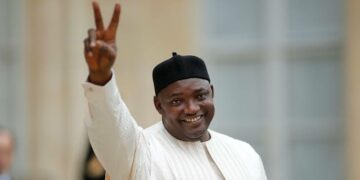




















The incumbent president of The Gambia, Adama Barrow, has won the country’s presidential election to serve for a second term in office.
Barrow, who contested the election under the flagship of the National People’s Party (NPP), polled 457, 519 votes to defeat his closest rival, Ousainou Darboe, of the United Democratic Party (UDP) who garnered 238, 253 votes.
Announcing the result, the Independent Electoral Commission (IEC) chairman, Alieu Momar Njai, said “Having received 457, 519 votes in the election, I hereby declare Adama Barrow duly elected to serve as president of The Gambia”.
It would be recalled that in 2016, as an independent candidate, a relatively unknown Barrow contested and won the presidential election, defeating long-time dictator, Yahya Jammeh.
In the result announced after the recent election, Barrow came victorious in 47 of the 53 constituencies in the country.
Barrow, who defeated dictator, Yahya Jammeh, in 2016 to become the country’s third president will now govern for the next five years.
Reacting to the development, Commonwealth observers said the unique but customary way Gambians cast their votes in the 2021 presidential election did not hinder transparency.
Issuing the Group’s interim statement in Banjul, Chairperson former President of Nigeria, HE Olusegun Obasanjo said: “The Gambia’s unique marble voting system has once again allowed all Gambians who voted to do so in a transparent manner.
“The Gambia’s unique marble voting system has once again allowed all Gambians who voted to do so in a transparent manner. While we note that there are different views on the value of this system.
“We therefore urge further dialogue to ensure that all Gambians are able to reflect thoroughly on this, as well as other areas, within the context of the unimplemented reforms that will need to be addressed in the next electoral cycle.”
Referring to press freedom, HE Olusegun Obasanjo said, “The Gambia have come a long way”, noting an improvement on previous elections.
However, the Group has recommended that the Independent Electoral Commission establishes a robust communication unit to which the public and press can submit complaints – as well as seek clarifications on issues pertaining to elections.
The Group commended the people of The Gambia for the largely peaceful, calm, and orderly way they cast their vote and appealed to them to maintain the same commitment in the post-election period, even as the country prepares to return to the polls in April 2022 for the legislative elections.