

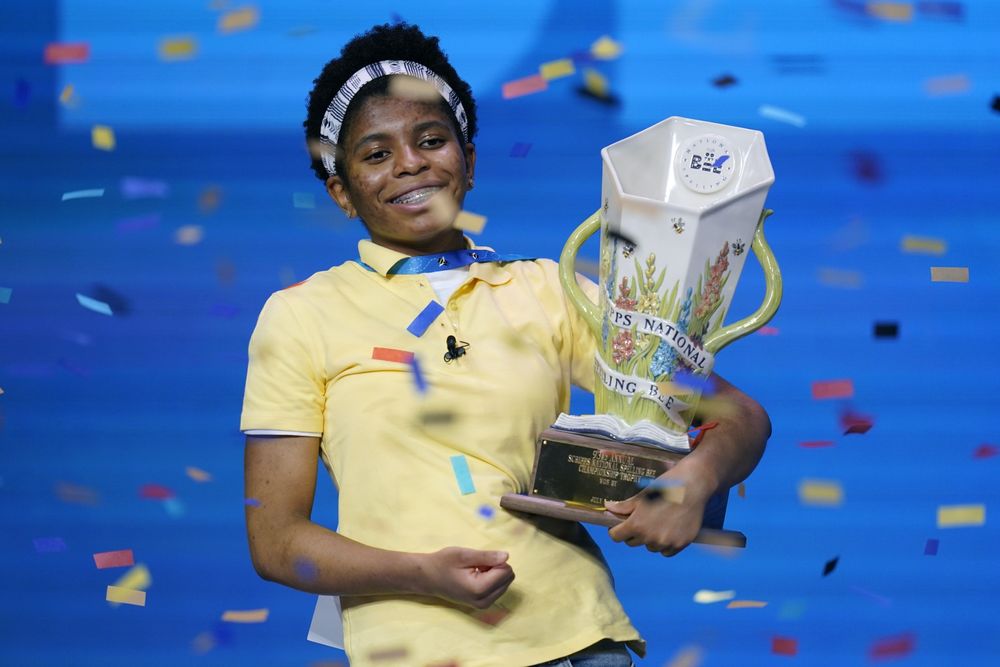
Zaila, a 14-year-old from Harvey, La., won on the word “Murraya” to become the first Black American to win the Scripps National Spelling Bee in almost 100 years.
The last word, after hundreds of competitors fell to some of the dictionary’s most colorful monsters, was “Murraya.”
When Zaila spelled it correctly on, she put her hands to her head filled with excitement and danced her way into spelling competition’s history as the first Black American to win the Scripps National Spelling Bee. The victory embellished Zaila’s already remarkable résumé: Not only has she competed in spelling bees for two years, she already holds three Guinness world records for dribbling, bouncing and juggling basketballs—all before the ninth grade.
“Now I get to get a nice trophy, which is the best part of any win,” she said in an interview on ESPN, which broadcast the contest. (She also won a $50,000 prize).
The next morning, she told “Good America” that she hoped to see more African American students “doing well in the Scripps Spelling Bee.”
The bee, she said, was a “gate-opener to being interested in education.”
Zaila’s journey from her hometown near New Orleans to the spelling bee finals in Orlando, La., spanned two years, 18 rounds of competition and tens of thousands of words.
During the competition, she faced not only a battery of obscure words like fidibus, ancistroid and depreter among others, but new spelling bee rules enacted after eight students were crowned co-champion in 2019.
The national spelling bee has been held for almost 100 years, and for decades, its organizers have used more difficult words from the realms of medicine, art, zoology and antiquity.
This year’s words were especially difficult, said Kory Stamper, a lexicographer and the author of “Word by Word: The Secret Life of Dictionaries.”
“I have the dictionary open in front of me, and I edited this dictionary, and I have not spelled any of these words right on the first try,” she said at one point. Most of the 11 finalist stumbled with words like chrysal, athanor, cloxacillin, heliconius, torticollis, platlyepadid and gewgaw, and at one point judges had to review a video replay to determine whether a speller said the letter I or Y. (He misspelled “ambystoma”).

Several spellers were eliminated in a round of questions about word meanings, which Ms. Stamper said was a return to spelling bees’ origin as a broader vocabulary exercise. “It wasn’t this gamified thing that we do now,” she said.
In the last few minutes of competition, it came down to two girls, Zaila and Chaitra Thummala, a 12-year-old from San Francisco.
The last few words were rattled off in a swift back-and-forth between them and the pronouncer.
First was “fewtrils” (things of little value), which Chaitra got right. Then “retene” (a chemical isolated especially from pine tar, rosin oil and various fossil resins), which Zaila spelled correctly. It was down to Chaitra to spell “neroli oil” (a fragrant pale yellow essential oil). Chaitra got it wrong.
That meant that Zaila could win it if she spells one more correct word.
Although she seemed puzzled by her word, “Murraya,” she grimaced a little. The pronouncer told her it meant a genus of tropical Asiatic and Australian trees having pinnate leaves with imbricated petals.
“Does this word contain like the English word ‘Murray,’ which would be the name of a comedian?” Zaila asked, referring to the actor Bill Murray and drawing laughs from the pronouncer and the judges.
She began to spell it, stopped herself, and asked for the language of origin (Latin from a Swedish name).
Then, as with so many words before, she needed little time to solve its structure. She spelled the word correctly.


