

By Stanley Ugagbe
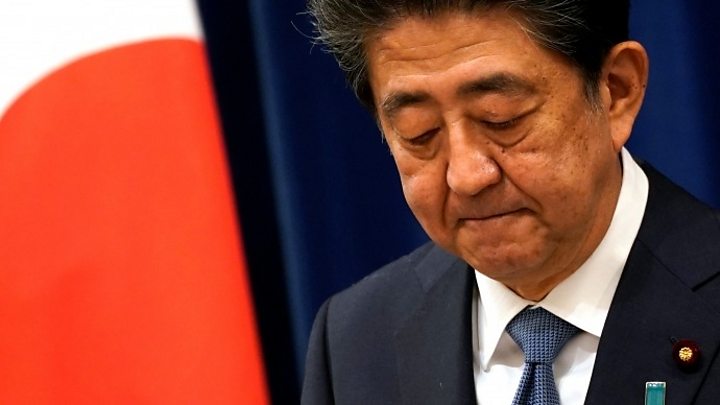
The Prime Minister of Japan, Shinzo Abe, has announced his resignation citing health reasons after being in office for two terms.
The Nigerian Canadian News gathered that Abe resigned his position after years of battling a chronic bowel disease—ulcerative colitis.
In a statement made available to newsmen, the leader succinctly averred that he wanted to avoid causing problems to the government because of his worsening condition. He has been in office for about eight years.
“I have decided to step down from the post of the prime minister. I cannot be prime minister if I cannot make the best decisions for the people,” Abe told journalists, stating that he was suffering from the same condition that ended his first term in office.
Meanwhile, there have been speculations on whether his health could afford him to stay in the job until the end of his term as ruling party leader in September 2021.
Abe stated that he had been feeling ill since mid-July but only found out that his health had relapsed this month.
While noting that though new treatment had begun for him, he had to resign.
He said “With the illness and treatment, and with my strength not the best, I can’t allow myself to risk making incorrect political decisions, thus failing to produce results. I intend to resign as prime minister”.
The leader apologized for having to leave office before term was over.
“I would like to sincerely apologise to the people of Japan for leaving my post with one year left in my term of office, and amid the coronavirus woes, while various policies are still in the process of being implemented”.
Nevertheless, he would remain as prime minister until his successor is chosen, he added.
Abe recently became Japan’s longest-serving leader after celebrating 2,799 days in office, setting a record previously held by his great-uncle Eisaku Sato half a century ago.
Meanwhile, his resignation has triggered off a leadership race in the country as it scrambles for a transition leader.
Though the retired leader said he would not comment on his potential successors, he said the next leader should continue to work on fighting the coronavirus.
The leadership race is being run within the ruling Liberal Democratic Party (LDP) where the winner will be formally elected in parliament.
Speaking on Abe’s administration, Jeff Kingston from Temple University in Tokyo said “He will be remembered for the longest-serving prime minister, but having been in power for so long with a super-majority in the Diet [parliament], he hasn’t really achieved all that much. And so maybe he has given stability and Japan has been governed reasonably well. But in terms of the ambitious agenda of Abenomics he really has achieved very little.
“He said he would decrease inflation, that hasn’t happened. He said ‘we’re going to raise wages’, that hasn’t happened. Households are not feeling the love, and so generally speaking Abenomics is often criticised for being welfare for the wealthy”.


