

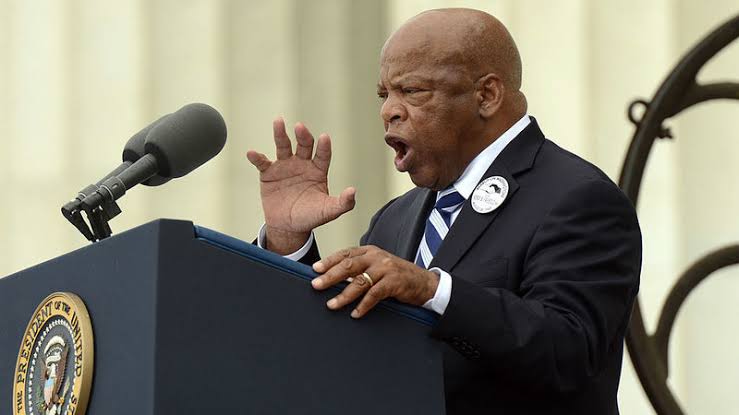
John Robert Lewis, a prominent figure of the civil rights movement and a US congressman, has died after a protracted battle with cancer. He died at the age of 80.
While announcing his death through a statement, his family said: “It is with inconsolable grief and enduring sadness that we announce the passing of U.S. Rep. John Lewis. He was honored and respected as the conscience of the US Congress and an icon of American history, but we knew him as a loving father and brother.
“He was a stalwart champion in the on-going struggle to demand respect for the dignity and worth of every human being. He dedicated his entire life to non-violent activism and was an outspoken advocate in the struggle for equal justice in America. He will be deeply missed.”
Also, House Speaker, Nancy Pelosi announced his death in a statement. The statement reads: “Today, America mourns the loss of one of the greatest heroes of American history: Congressman John Lewis, the Conscience of the Congress.”
Lewis had promised to fight the disease after his announcement in December 2019 that it had been discovered he had stage 4 pancreatic cancer which was detected as a result of a routine medical visit and test.
At that time, he said: “I have been in some kind of fight — for freedom, equality, basic human rights — for nearly my entire life. I have never faced a fight quite like the one I have now.”
Lewis, served as the US representative for Georgia’s 5th Congressional District for over three decades. He was perceived as a moral conscience of Congress owing to his years of non-violent agitation for civil rights. He was a passionate orator whose skill was evident in long record of action that included over 40 arrests while protesting against racial and social injustice.
While following Martin Luther King Jr., he took part in lunch counter sit-ins and became a keynote speaker at the historic 1963 March on Washington at the age of 23.
While talking about the civil rights movement, Lewis said: “Sometimes when I look back and think about it, how did we do what we did? How did we succeed? We didn’t have a website. We didn’t have a cellular telephone.
“But I felt when we were sitting in at those lunch counter stools, or going on the Freedom Ride, or marching from Selma to Montgomery, there was a power and a force. God Almighty was there with us.”
Lewis led a march for voting rights on the Edmund Pettus Bridge in Selma at the age of 25. During the March, Lewis and other marchers were attacked by armed state and local police with clubs and Lewis got his skull fractured during the attack.
While talking about the attack, he said: “I gave a little blood on that bridge,” he said years later. “I thought I was going to die. I thought I saw death.”
In spite of the attack and other sufferings, Lewis did not lose his activist spirit as he was taking it from protests to politics. As a result of his unrelenting activism, he was elected to the Atlanta city council in 1981 and was elected to the Congress six years later.
When he got to Washington, he paid attention to fighting against poverty and helping younger generations by improving healthcare and education. Also, he co-wrote graphic novels about the civil rights movement and won a National Book Award.
Lewis was happy to witness an African American elected President and he described that moment as a moment he never thought would happen in spite of his fight for equality.
He categorised attending President Barack Obama’s 2009 inauguration as an “out-of-body” experience.
He said: “When we were organizing voter-registration drives, going on the Freedom Rides, sitting in, coming here to Washington for the first time, getting arrested, going to jail, being beaten, I never thought — I never dreamed — of the possibility that an African American would one day be elected president of the United States.”
Lewis received the nation’s highest civilian honor, the Presidential Medal of Freedom in 2011. The Medal of Freedom was placed round his neck by America’s first Black President, Barrack Obama.
While paying tribute to Lewis, Obama said in a statement that the civil rights icon will “continue, even in his passing, to serve as a beacon” as America strives to have a more perfect union.
Obama said: “He loved this country so much that he risked his life and his blood so that it might live up to its promise. And through the decades, he not only gave all of himself to the cause of freedom and justice, but inspired generations that followed to try to live up to his example.”


