

With the Canadian federal election slated for September 20, analysts are beginning to x-ray the chances of the various aspirants especially Erin O’Toole and his party, Conservative. Historically, Canada’s government has only ever been led by Liberals or Conservatives. Other parties running in this year’s election include the Bloc Québécois, the New Democratic Party, and the Green Party, among others.
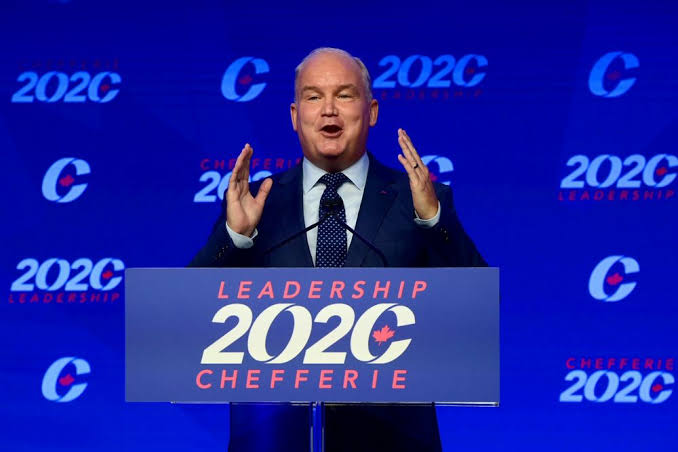
Like the previous federal election, the Conservatives entered the race in second place. Like 2019, they also have a new leader at the helm of the party. Erin O’Toole won the 2020 Conservative leadership election in an upset over Peter MacKay, widely considered the front-runner.
Records have it that the 2021 election marks the first introduction to O’Toole for many Canadians and pundits are of the view that so far, this introduction hasn’t gone very well — O’Toole is the least popular party leader among Canadians.
It would be recalled that Party leadership was an important factor in the Conservative election loss in 2019, when former leader Andrew Scheer failed to shed his personal baggage as a well-known social conservative and project an authentic image to Canadian voters.
It is believed that countering negative perceptions of O’Toole entering into the election will be key for the Conservatives to grow their share of seats in 2021. But who exactly is Erin O’Toole?
It is important to clarify that O’Toole is a long-standing member of the Conservative Party, serving in former Prime Minister Stephen Harper’s cabinet. He ran previously for the party leadership in 2017. Representing the Ontario riding of Durham, O’Toole fits the ideological profile of a “Red Tory” defined by a combination of progressive positions on social issues balanced with a commitment to fiscal conservativism.
Reports have it that O’Toole’s early run as Conservative leader has shown a willingness to depart from this ideological orientation for strategic gains. In the 2020 Conservative leadership election, O’Toole presented himself to party members as a would-be populist by rallying support around the slogan “Take Back Canada.”
Among others, O’Toole’s campaign included promises to re-establish law and order by jailing anti-energy activists, to defend Canadian history and values against cancel culture and to take a hardline stance against the Communist Party of China.
Remarkably, O’Toole’s leadership campaign and slogan earned scathing comparisons to former United President, Donald Trump. In a country built through Indigenous dispossession and systemic racism, many were quick to wonder from whom O’Toole wanted to take back Canada.
However, while aping exclusionary populist rhetoric, O’Toole cleverly avoided direct attacks toward immigrants in his leadership campaign. Recall that these types of attacks contributed to the Conservatives’ loss in 2015 and helped sink the careers of former leadership hopefuls like Kellie Leitch and Maxime Bernier.
Rather, O’Toole’s brand of populism helped communicate a message of ideological authenticity and strong leadership that allowed him to upset MacKay, another Red Tory.
While O’Toole enters the election with low popularity, he and the party are trying hard to build a more positive image of their leader. Though, the dominant conversation of the 2021 federal election is Canada’s post-pandemic economic recovery, for Conservatives, this election is also about O’Toole and whether his masculine brand of pragmatic conservativism resonates with voters. And the ultimate question is; will O’Toole deliver for the Conservatives?


