

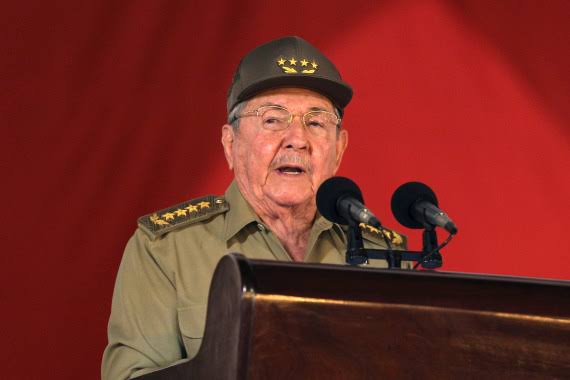
89-year-old Raul Castro has announced his resignation as head of Cuba’s Communist Party, ending an era of formal leadership by him and his brother Fidel Castro that began with the 1959 revolution.
Local reports have it that Castro disclosed the development in a speech at the opening of the Eighth congress of the ruling party, the only one allowed on the island.
In his words, Castro averred that he was retiring with the sense of having “fulfilled his mission and confident in the future of the fatherland.”
He, however, didn’t say who he would endorse as his successor as first secretary of the Communist Party.
Nevertheless, reports said he previously indicated that he favors yielding control to 60-year-old Miguel Diaz-Canel, who succeeded him as president in 2018 and is the standard bearer of a younger generation of loyalists who have been pushing an economic opening without touching Cuba’s one-party system.
Remarkably, his retirement means that for the first time in more than six decades Cubans won’t have a Castro formally guiding their affairs, and it comes at a difficult time, with many on the island anxious about what lies ahead, reports said.
Reports said much of the debate inside Cuba is focused on the pace of reform, with many complaining that the so-called “historic generation” represented by Castro has been too slow to open the economy.
It would be recalled that Fidel Castro, who led the revolution that drove dictator Fulgencio Batista from power in 1959, formally became head of the party in 1965, about four years after officially embracing socialism.
It was gathered that he quickly absorbed the old party under his control and was the country’s unquestioned leader until falling ill in 2006 and in 2008 handing over the presidency to his younger brother Raul, who had fought alongside him during the revolution.
It should be noted that Raul succeeded him as head of the party in 2011. Fidel Castro died in 2016.


