

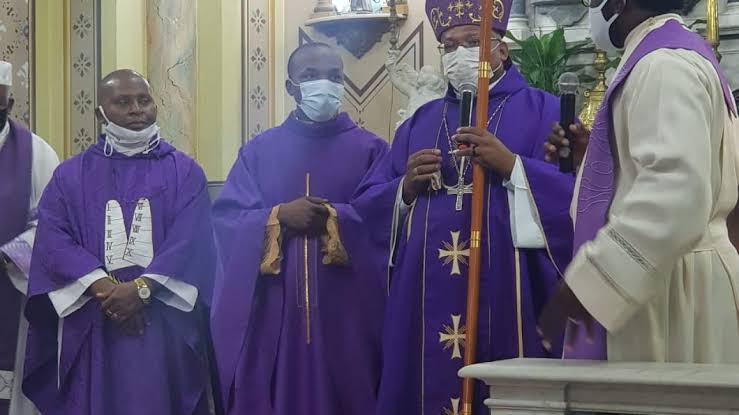
Catholic news outlet, Crux has reported that the Archdiocese of São Paulo has created a personal chaplaincy for Nigerians, who constitute one of the biggest African communities in Brazil’s largest city.
The chaplaincy is named after Saint Josephine Bakhita and it will serve both immigrants and refugees that have felt estranged from a Church where according to them, they couldn’t feel at home.
While talking about the chaplaincy’s creation, Ikenna Kingsley Ojukwu, a Catholic layman that was key in the formation of the chaplaincy said: “Most Nigerians don’t speak Portuguese and can’t understand anything during Mass. So, many of them end up joining a Neo-Pentecostal church in which services are held in English.”
Ojukwu saw the need to establish a Catholic community for Nigerians living in São Paulo when he journeyed to Nigeria in 2019 to visit his relatives. During the visit, he met Father Modestus Oguchi Alozie in Anambra state and asked him to visit Brazil during his next vacation.
Alozie said: “When I came to São Paulo, I didn’t have any plan to work with the Nigerians here. But I heard them continually complaining about the linguistic barriers they faced in church. Many people asked me to celebrate.”
That was when they decided to meet with Auxiliary Bishop Eduardo Vieira.
Not long after the meeting, Cardinal Odilo Scherer, the Archbishop of São Paulo, approved the establishment of a chaplaincy.
Majority of the 3,300 Nigerians residing in São Paulo are Catholic men who travelled out of Nigeria to search for better life in Brazil and they are mostly from Southeast Nigeria. Also, there are some Northern Muslims and Yorubas. Eventually, some of them brought their families, but most of them live in São Paulo alone and send money home.
Father Paolo Parise, coordinator of Mission Peace, a Scalabrinian center that offers short-term shelter for immigrants and refugees in São Paulo, said a lot of Nigerians in Brazil had come running away from Islamist terror. He added that Nigerians encounter police profiling in Brazil due to the activities of one Nigerian drug mafia in the country.
Ojukwu said many of them are observant churchgoers and noted regretfully that Brazil, a predominantly Catholic nation, has citizens who hardly observe the sacraments.
Father Alozie said: “During confession, some Nigerians told me they hadn’t received the sacraments for five, 10, or even 13 years. And they thanked me for bringing God back to them.”
Festus Ogbogu Okoye migrated from Nigeria to São Paulo in 2001. As a Catholic, he was studying to be a priest in his home country but he never ceased to go to church in Brazil, in spite of the linguistic differences.
While talking to Crux, Okoye said: “The blessings are the same, but it’s a different experience. When the Mass is your language, you feel at home.”
According to Alozie, the celebration of the creation of the chaplaincy united dozens of people not only from Nigeria, but also from other Anglo-phone African countries, like Ghana and South Africa.
He said: “Even people from French-speaking Burkina Faso attended our Mass. They felt close to their African brothers and joined us. The growing number of attendants will probably require a larger church in the future.”


