

By Stanley Ugagbe
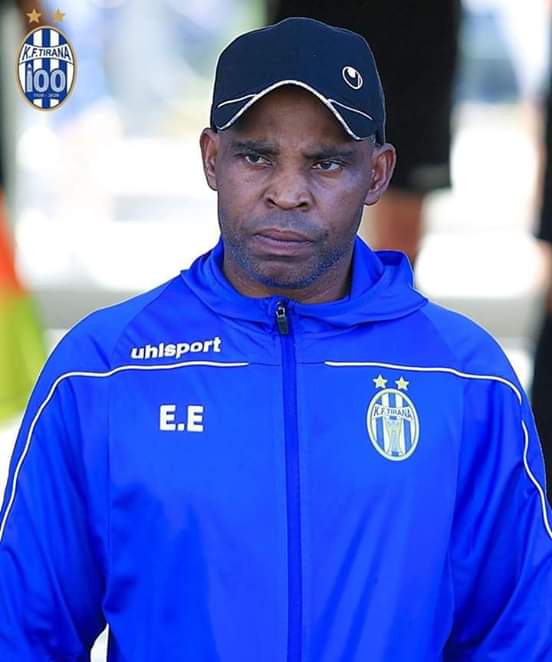
AGAIN, another Nigerian, NdubuisiEgbo has made history by guiding Albania’s KF Tirana to top flight in their century year.
With the feat, Egbohas become the first African coach to lead a European team to a league title, and qualification for the UEFA Champions League — or any European competition.
For a team that has now won the Albanian league title 25 times — more than any other club in the country — Tirana being crowned champions again was a huge achievement and a relief, given they were nearly relegated the season prior.
The history maker, beamed with joy is still coming to terms with the achievement — especially given that he had taken over as manager with the side in perilous waters in late 2019.
Speaking with newsmen, Egbo said “It’s unexplainable.I am still trying to let it sink in because I didn’t know how huge the success of what God used us to do was until I started hearing I’m the first African coach to achieve this feat. Many people from Nigeria, Egypt — where I played before — and other places have been reaching out.”
Recall that in 2014, the former Nigeria goalkeeper joined the club, for whom he had played, as goalkeeper trainer and assistant coach.
He was asked five times thereafter to step in on an interim basis when a manager was sacked — handed the reins for a combined total of five games, with four losses and one draw.
Egbodeclined previous offers to take the job on a full-time basis: “But I told them it is a big job, so I would wait for the right time to get more experience.”
However, he was asked to fill in, once again, on a three-game basis when yet another manager was fired, after a run of poor results left the club languishing in eighth place and contemplating the real threat of relegation.
Egbo said he dug into his Nigerian roots to turn things around.
“When I took over this time, I felt like I had got the experience passing through many coaches, learning from all the coaches that I have worked with in the club, coupled with everything I have learnt from my career and all the coaches I worked with — especially back home,” he said.
“Coaches like Christian Chukwu and Joe Erico, one of the best coaches I have gone through in my career, who taught me more than just about football. And his lessons got me to where I am today.
“Also his playing pattern. They used to say back then that if you don’t come to the stadium on time, you won’t see our first goal. That is the way I have my team playing here. We attack as a team and defend as a team.”
The history maker stated he had to do a lot of “psychological work” with the Tirana players, whom, he said, “had lost the winning mentality, they had lost character, and they had lost personality.”
“They were completely down and knocked out, and you can’t imagine the psychological work that we did just to get them back”.
“I played for this team, and in two out of the three years we won the league, the cup and Super Cup; we needed to bring that winning mentality back, and that is what we did.
“You need to put fear in opponents, and when you get into a game, you have to enter like a king into the arena. It’s your arena, and no one else should command it apart from you.
“[This is the] winning mentality every team should have, and this is the mentality and culture of this team, KF Tirana. This is a team that when they go away, they go to get a win and not a draw because draw away is like a loss.”
Egbo’s accomplishment comes at a time when the world is confronting social justice issues sparked by the killing in the United States of George Floyd — and at a time that features growing calls for more diversity in sports leadership positions.
“I believe it is a calculated time. It’s God’s timing that He made everything to work out this way. One hundred years of the club, and for a foreigner to come and do it, that is unimaginable. That is why many of them can’t accept it in Albania; they can’t accept that a Black man, a foreigner, will come and win the league… they tried everything to ensure it doesn’t happen,” he said of his success.
That is still some way out, however; for now, Egbo hopes that his achievements can open the door for other African coaches.
“I hope this achievement isn’t only for me,” he said, “but it will help other African coaches to be given opportunities to showcase what they can do and to be an encouragement to push them to do more for themselves.”


