

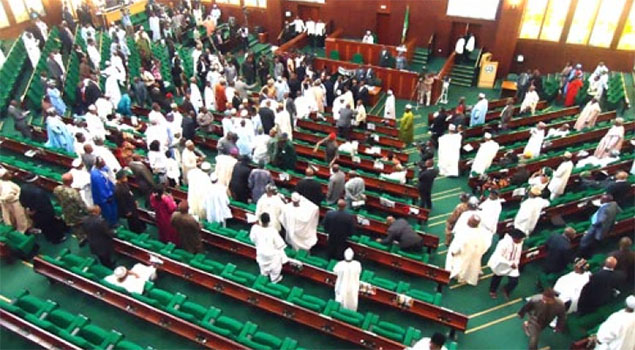
Nigeria’s House of Representatives is considering a bill to penalize employers who fail to pay their workers’ salaries on time.
The proposed bill, titled the Employees Remuneration Protection Bill, has been introduced to tackle the issue of delayed or unpaid wages across the country.
It is sponsored by Wale Hammed, a member representing the Agege federal constituency of Lagos State.
The bill has passed its first reading in Section 7 (1) and it states that “it shall be unlawful for any employer to refuse or neglect to pay the remuneration of his employees, as provided under this Act.”
The bill states further in Section 8 (1) that “where an employee’s remuneration is unpaid after the expiration of the period allowed by this bill, the employee, who desires to claim his entitlement, shall serve upon his employer a written demand for the payment of entitlement.”
Meanwhile, it provides that “where a demand is served pursuant to Section 9 of this bill and the employee remains unpaid after five working days, the employee may apply to the court by way of motion on notice for redress.”
The proposed legislation consequently prescribes a jail term of three to six months, without the option of a fine, for employers convicted of non-payment of their workers’ salaries.
For a corporate body that fails to comply with the order of a court for the payment of its employee(s), it shall be liable for a fine of N10,000 for each day of the default, “be sealed off for a period of time not exceeding three months, where the default is more than two months.”
Alternatively, the proposed legislation prescribes the “committal of every officer or agent of the company, government parastatal, agency, body or institution, who knowingly or wilfully authorizes or permits the default or failure to a fine of N10,000 until the order is complied with.”
According to the bill, employers are expected to give the employee written terms of employment for employment, which is for over one month, not later than 14 working days, after the resumption of the employee.
The employment contract, which will be signed by the employer and the employee, will detail the nature of the employment, the way through which it shall be terminated by either of the parties, remuneration, methods of payment, and terms and conditions.
Furthermore, Section 27 of the proposed legislation states that the employee’s application to the court for the payment of his salary should not be the basis for any “disciplinary action, query, suspension or dismissal of the applicant by the employer.”


