


















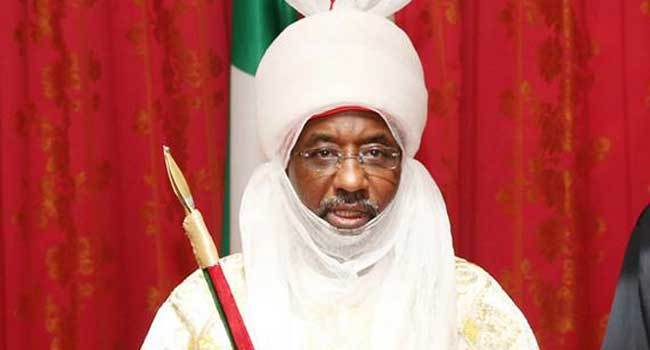
Former CBN governor, Sanusi Lamido Sanusi, has said that Nigeria’s dependence on oil production alone cannot guarantee the country’s prosperity.
Sanusi made this known recently while delivering the keynote lecture at the Distinguished Lecture Series of the Nigerian Institute of International Affairs (NIIA) in Lagos.
According to him, Nigeria’s dependence on oil is not a working strategy to enrich us; however, it can put the country in great trouble.
Sanusi observed that it’s paramount to bring the economy into public discourse because that’s the only way through which Nigeria’s economic predicament can be tackled.
He referenced oil-producing countries like Saudi Arabia, Kuwait and Gabon, he stated the country merely produced 2.3 million barrels per day while Gabon produces 31.7 million barrels per day, Saudi Arabia produces 91.4 million barrels per day and Kuwait produces 221.6 million barrels per day.
He commended President Tinubu for removing subsidy and unifying the multiple exchange rate and noted that these two structural reforms will foster the economic growth in the country.
He also stated that he revealed the danger subsidy and multiple exchange rates posed to the economic landscape in 2011 but many people refused to listen to him because of vested interest.

He said: “If the state is a rentier state where the people in control see it as an avenue to make money for themselves and their families, they are never going to run an economy that encourages production and growth. If it is run by people who are thinking long-term and of the legacy they will leave behind for their children and the future of the country, they will run different sets of different policies. I think every economist knows that multiple exchange rates are a problem, but as long as politicians are able to give themselves a dollar at 400 Naira and sell at 700 Naira, they are not ready to listen to the economists, We said, if we did not do something about those subsidies, we would end up where we are today.”
Sanusi advised the President to diversify the economy from oil as a long-term strategy to the present economic challenges.
He said though conditional cash transfer can be deployed to cushion the effect of these reforms in the short term, the government should put in place a long-term plan to ensure that Nigeria becomes a productive state.
He said: “In the short term, the most effective measure to offset the removal of fuel subsidies is cash transfers. The design of individual cash transfer programmes varies considerably in reach and coverage. The long-term solution is to reduce dependence on PMS.”
SUPPORT NIGERIAN CANADIAN NEWSPAPER CANADA
If you like our work and want to keep enjoying what we offer, kindly support us by donating to the Nigerian Canadian News by clicking here
Share your thoughts in the comments section below
Do you want to share any news or information with us? If yes, contact the publisher at publisher@test1.nascitest.club