

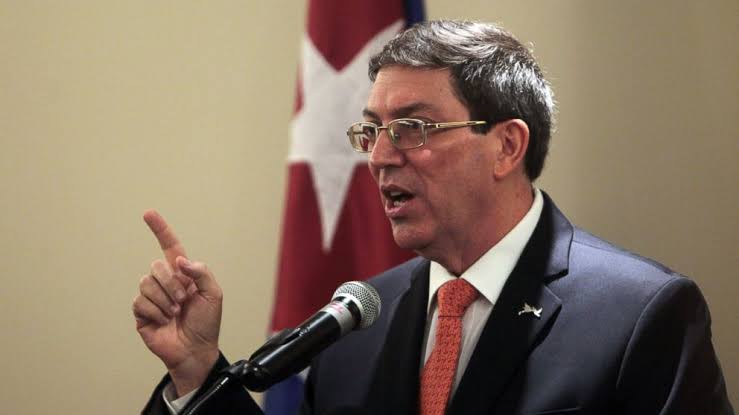
The Government of Cuba has accused the United States of seeking to destabilise the island, even as protests continue to rock the nation despite a government ban on the demonstrations.
It would be recalled that the country was rocked by rare public protests in July, as demonstrators took to the streets for two days in anger over the rising cost of living, food shortages and the continuing US embargo, among other issues.

In a statement, Cuban Foreign Minister Bruno Rodriguez said the government would not allow “the persistent aggression by the United States government, its intense and constant attempts … to create conditions for internal destabilisation, to alter the citizens’ calm and security”.
Cuba had in October rejected protest organizers’ request to demonstrate, claiming the so-called “Civic March for Change” would be a “provocation” supported by the US with the aim of leading to regime change.
Rodriguez said “There have been 29 statements from the United States government and influential figures in that nation’s congress since September 22 alone … all aimed at encouraging, guiding, instigating destabilisation actions in our country”.
Havana’s public prosecutor’s office has warned protest organisers about the “criminal consequences” they face if they go ahead with their plans – but the opposition remains unbowed and has promised to hold the demonstrations.
Following plans to launch a fresh protest by the opposition party, Michael Bustamante, an expert on Cuba at the University of Miami, said the timing of the opposition demonstrations could explain “the intensity of the state’s response”.
Speaking with newsmen, Bustamante said “This is the moment where the Cuban state is looking to turn the corner on what has been a very bad year … and here you have this group saying, ‘no, we are choosing this specific moment to press for political change”.
It should be noted that the Cuban authorities prosecuted dozens of people in relation to the protests on July 11 and 12.
Hundreds of people were arrested during those demonstrations and many faced charges of contempt, public disorder, vandalism and propagation of the coronavirus for allegedly marching without face masks. At least one person died during the two days of unrest.
In a swift reaction, US President Joe Biden’s administration imposed fresh sanctions on Cuba following the protests.
“We hear the cries of freedom coming from the island. The United States is taking concerted action to bolster the cause of the Cuban people,” Biden said at the start of a White House meeting with Cuban Americans in late July.


